Best Practice: Model Visually (UML)
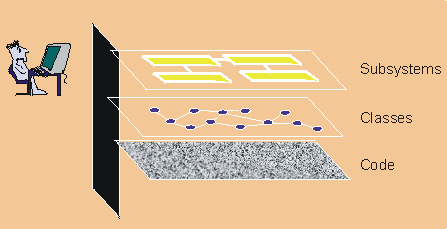
Visual modeling raises the level of abstraction
Topics
Visual modeling is the use of semantically rich, graphical and textual design
notations to capture software designs. A notation, such as UML, allows the level
of abstraction to be raised, while maintaining rigorous syntax and semantics. In
this way, it improves communication in the design team, as the design is formed and
reviewed, allowing the reader to reason about the design, and it provides an
unambiguous basis for implementation.
A model is a simplified view of a system. It shows the essentials of
the system from a particular perspective and hides the non-essential
details. Models can help in the following ways:
The importance of models increases as systems become more complex. For
example, a doghouse can be constructed without blueprints. However, as one
progresses to houses, and then to skyscrapers, the need for blueprints becomes
pronounced.
Similarly, a small application built by one person in a few days may be
easily understood in its entirety. However, an e-commerce system with tens
of thousands of source lines of code (SLOCs)—or an air traffic control system
with hundreds of thousands of SLOCs—can no longer be easily understood by one
person. Constructing models allows a developer to focus on the big
picture, understand how components interact, and identify fatal flaws.
Some examples of models are:
- Use Cases to unambiguously specify behavior
- Class Diagrams and Data Model Diagrams to capture design
- State Transition Diagrams to model dynamic behavior
Modeling is important because it helps the team visualize, construct, and
document the structure and behavior of the system, without getting lost in
complexity.
Simple models can be created and modified at a low cost to explore design
alternatives. Innovative ideas can be captured and reviewed by other
developers before investing in costly code development. When coupled with
iterative development, visual modeling helps developers to assess design changes
and communicate these changes to the entire development team.
Today many projects employ object-oriented programming languages to obtain
reusable, change-tolerant, and stable systems. To obtain these benefits, it's
even more important to use object technology in design. The Rational Unified
Process (RUP) produces an object-oriented design model that is the basis for
implementation.
With the support of appropriate tools, a design model can be used to generate
an initial set of code for implementation. This is referred to as
"forward engineering" or "code generation". Design
models may also be enhanced to include enough information to build the system.
Reverse engineering may also be applied to generate design models from
existing implementations. This may be used to evaluate existing
implementations.
"Round trip engineering" combines both forward
and reverse engineering techniques to ensure consistent design and code. Combined with an iterative process, and the right tools,
round-trip
engineering allows design and code to be synchronized during each
iteration.
Before building a system, it's critical to capture the requirements.
Specifying the requirements using a precise and unambiguous model helps to
ensure that all stakeholders can understand and agree on the
requirements.
A model that separates the external behavior of the system from the
implementation helps you focus on the intended use of the system, without getting
bogged down in implementation details.
The RUP uses the Unified Modeling Language (UML), a consistent
notation that can be applied for system engineering as well as business
engineering. A standard notation serves the following roles (see [BOO95]):
- "It serves as a language for communicating decisions that are not
obvious or cannot be inferred from the code itself."
- "It provides semantics that are rich enough to capture all important
strategic and tactical decisions."
- "It offers a form concrete enough for humans to reason and for tools to
manipulate."
UML represents the convergence of the best
practice in software modeling throughout the object-technology industry. For more information on the UML, visit
our Web site at http://www.rational.com/uml.
Copyright
© 1987 - 2001 Rational Software Corporation
|  Overview >
 Best Practices >


